
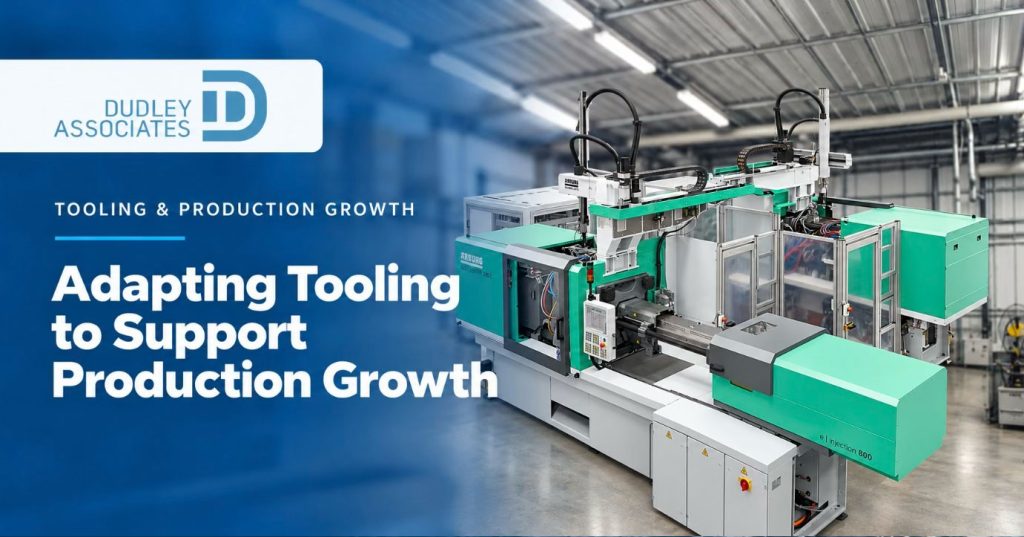
Tooling designed for a new concept does not always remain the best tooling for a successful product.
Around five years ago, a warehouse-management technology company approached Dudley Associates with a new locker system for handheld and mobile devices. At that stage, the priority was establishing a practical manufacturing route for a new product with relatively modest forecast volumes.
Dudley manufactured a suite of eight injection mould tools. The system subsequently gained commercial traction and production requirements increased.
The original tooling matched the original risk
Early in a product’s life, it can be sensible to avoid investing in automation that the forecast volume does not yet justify. Some of the original tools therefore used loose inserts. This allowed the required geometry to be moulded without committing to a more complex automatic mechanism.
The compromise was additional manual handling. As order volumes increased, the time required to load and remove the inserts became a more significant part of the moulding cycle. A tooling decision that had been proportionate during launch was beginning to restrict production efficiency.
Replacing loose inserts with sliders
Dudley reviewed the component and tool design to identify where automation could now deliver a meaningful return. The design was modified so that sliders could replace the loose inserts.
This reduced manual intervention and shortened the moulding cycle. Because Dudley understood the original tools, component intent and production history, the modification could be approached as a targeted improvement rather than a complete restart.
“The tooling work was completed at a significantly reduced price to support the customer's ramp-up. The shorter cycle then allowed the moulding cost to be reduced, helping the customer benefit from the efficiency improvement during repeat production.”
Brett Nixon, Production Manager | Dudley Associates Ltd
Preparing the system for further customisation
The next stage concerns one component that may need to support different colours or material variants for individual end users. A colour change can sound straightforward, but a change in polymer or grade may introduce different shrinkage behaviour.
Dudley is therefore reviewing whether the cavitation needs to be modified to protect fit and assembly across the proposed variants. This work is another example of why existing production tooling should be managed as a long-term manufacturing asset rather than treated as a fixed object after launch.
The wider lesson
Tooling strategy should reflect the current stage of the product. A lower-cost, manual solution may be correct during launch. If the product succeeds, selected automation and tool modifications can help production scale without immediately replacing an entire suite of tools.
“For us, future-proofing the customer’s investment does not mean over-engineering the tooling from day one. It means selecting the right solution for the current volumes while considering how the tool could be adapted if demand increases. Where possible, targeted modifications and automation can extend the life and capability of the original investment without forcing the customer to start again.”
Katie Weston, Technical Sales Manager | Dudley Associates Ltd
The important part is recognising when the economics have changed and using real production data to decide where investment will have the greatest effect.
Assess whether existing tooling can support growth
If production volumes have moved beyond the assumptions used when your tools were designed, Dudley Associates can review cycle time, manual operations, maintenance and component design to identify proportionate improvements.
Frequently asked questions
Why would a mould tool use loose inserts?
Loose inserts can create geometry that would otherwise require more complex moving tool features. They can be proportionate for low volumes, but they add manual handling and can extend the cycle.
What does a slider do in an injection mould tool?
Does increasing volume always mean replacing the tool?
Why can a material change require a tooling change?
Different polymers and grades can shrink at different rates. If the cavity remains unchanged, critical dimensions, fit and assembly may move outside the required tolerance.
