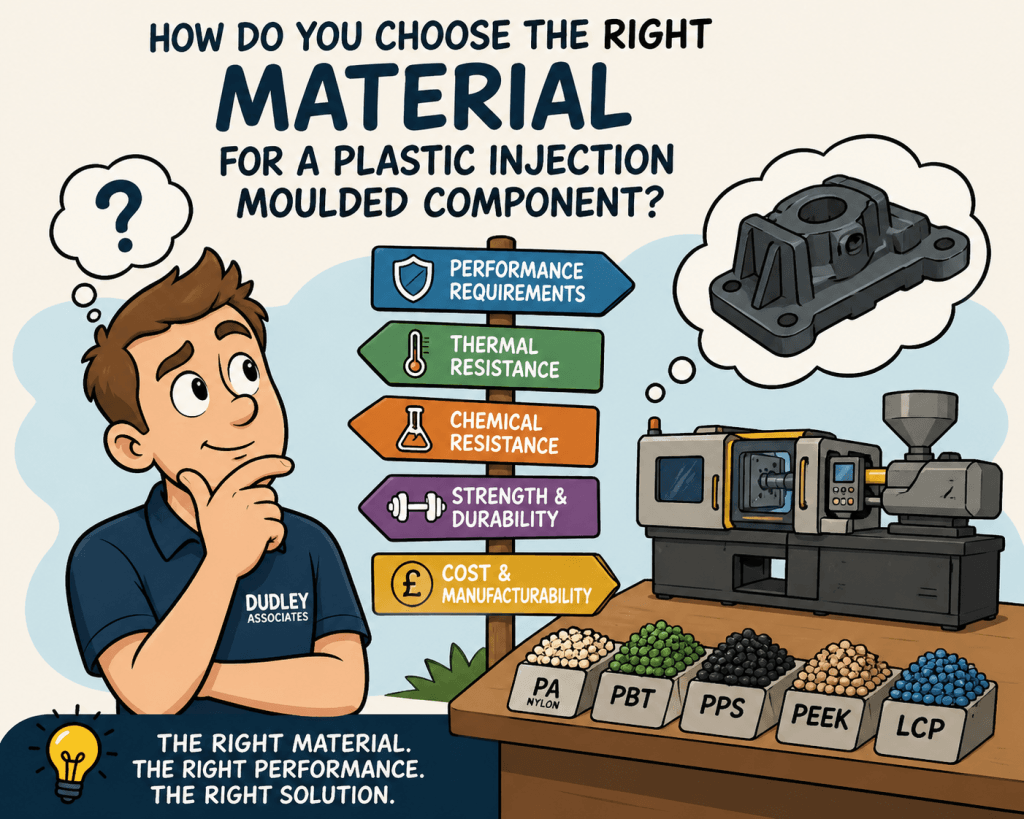
When it comes to plastic injection moulding, material selection is one of the earliest—and most critical—engineering decisions in the entire product development process.
Choosing the right polymer is about far more than simply selecting “a plastic.” The material you choose will directly influence the component’s mechanical performance, thermal resistance, chemical compatibility, dimensional stability, electrical properties and long-term reliability.
Get it right, and you create a part that performs consistently in demanding environments.
Get it wrong, and the consequences can range from poor aesthetics and premature wear to part failure in the field.
For technical, high-performance components, material selection should never be an afterthought.
Not All Plastics Are Created Equal
One of the most common misconceptions in engineering is to think of plastic as a single category of material.
In reality, polymers vary significantly in performance, cost and application.
At the most basic level, materials can be grouped into three broad categories:
Commodity Polymers
These are typically used in high-volume, cost-sensitive applications where performance demands are relatively low.
Examples include polypropylene (PP) and polyethylene (PE).
They offer good processability and low cost, but may not provide the mechanical or thermal properties required for technical components.
Engineering Polymers

Engineering-grade materials offer improved strength, stiffness, wear resistance and dimensional stability.
Examples include polyamide (PA / Nylon) and polybutylene terephthalate (PBT).
These are commonly used in automotive, industrial and electrical applications.
High-Performance Polymers

For the most demanding applications, high-performance polymers provide exceptional thermal, chemical and mechanical performance.
Examples include polyether ether ketone (PEEK), polyphenylene sulphide (PPS) and liquid crystal polymer (LCP).
These materials are often specified in environments involving high heat, aggressive chemicals or precision electrical performance.
While premium materials come at a higher cost, they can reduce long-term risk, improve service life and unlock performance that lower-cost alternatives simply cannot achieve.
Defining the Performance Requirements
Before selecting a material, it’s important to understand exactly what the part needs to do.
Questions to ask early in the design stage include:
- Will the component be load-bearing?
- Will it be exposed to high or fluctuating temperatures?
- Does it require electrical insulation or conductivity?
- Will it face chemical exposure or moisture ingress?
- Are tight tolerances or dimensional stability critical?
- Is UV exposure a factor?
- Does it need to meet regulatory or industry-specific standards?
The answers to these questions help narrow down the right material family and grade.
Designing for Demanding Environments
Technical injection moulded components are often required to perform in harsh operating conditions.
Material selection becomes even more critical when parts are exposed to real-world stresses.
Automotive & EV Applications
Under-bonnet automotive components must withstand elevated temperatures, vibration and exposure to oils and fluids.
In electric vehicles and battery systems, materials may also need excellent electrical insulation and flame-retardant properties.
Medical & Industrial Environments
Components used in medical or industrial applications may require chemical resistance, sterilisation compatibility or resistance to cleaning agents.
Aerospace & Marine Applications
In aerospace, defence, and marine sectors, lightweighting is often a key objective.
High-performance polymers can help reduce weight without compromising structural integrity.
Material Selection and Tooling Go Hand in Hand
At Dudley Associates, we know that selecting the right material is only part of the equation.
Material choice has a direct impact on tooling design and moulding strategy.
For example, glass-filled or mineral-filled polymers can be highly abrasive, increasing tool wear and influencing steel selection and coating requirements.
Certain materials require specialist gate designs, optimised venting and advanced cooling strategies to achieve consistent fill and minimise defects.
Each polymer also behaves differently in terms of:
- Flow characteristics
- Shrinkage rates
- Warpage tendencies
- Cycle times
- Surface finish
A component designed in isolation—without considering how the material will behave in the mould tool—can lead to costly delays, redesigns and performance issues.
This is why early collaboration between designers, moulders and toolmakers is so valuable.
The Cost of Getting It Wrong
Selecting the wrong polymer can result in:
- Premature component failure
- Cracking or deformation under load
- Poor chemical or heat resistance
- Dimensional instability
- Increased scrap rates or moulding defects
- Higher overall project costs through redesign and revalidation
While lower-cost materials may seem attractive initially, the long-term cost of failure can far outweigh any upfront saving.
Engineering the Right Solution
The best material selection decisions are made when performance requirements, manufacturing considerations and tooling expertise are all considered together.
At Dudley Associates, we work closely with customers from the earliest stages of development to ensure every component is designed with the right material, the right tooling strategy and the right manufacturing process in mind.
Because when it comes to technical injection moulded parts, the right material doesn’t just shape the component…
…it shapes the performance of the final product.
We would love to hear about your next market-leading product…