A Practical Guide to Turning an Idea into a Manufactured Injection Moulded Product
You might have a CAD model.
You may have refined the geometry.
You might even have a prototype sitting on your desk.
Or sometimes, you haven’t even got that far yet.
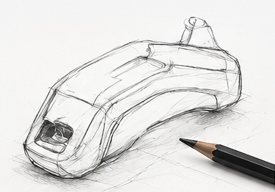
Sometimes it starts with nothing more than a sketch, a concept, or an idea that needs turning into something manufacturable.
Now comes the next question:
“How do I actually turn this into a moulded production component?”
For many design engineers, product developers and start-ups, this is the point where uncertainty creeps in.
Who do you speak to first?
Does the design need changing?
What material should you use?
How expensive will the tooling be?
Can the component actually be moulded efficiently?
At Dudley Associates, these are conversations we have every week.
And while every project is different, the successful ones usually follow the same principle:
The earlier manufacturing expertise is introduced into the design process, the smoother the journey from concept to production becomes.
Injection Moulding Isn’t Just About Making Parts
There’s a common misconception that injection moulding starts once the design is complete.
In reality, the opposite is often true.
The most successful moulded products are developed collaboratively — where tooling engineers, moulders and designers work together before the first tool steel is ever cut.
That’s because a component can look perfect on-screen while still being:
- Difficult to tool
- Prone to warpage
- Over-engineered
- Too expensive to manufacture
- Impossible to eject reliably
- Unsuitable for the chosen polymer
- Unrealistic for the required production volume
This is where design for manufacture (DFM) becomes critical.
So… What Happens After You Have a Design?
1. The Initial Technical Review
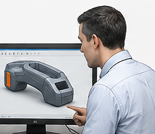
The first step is usually a detailed review of the component design.
At Dudley Associates, this isn’t simply a case of quoting for a tool. We treat this stage extremely seriously and review both commercial and technical feasibility.
Taking a consultative approach — we look at the application, performance requirements, expected volumes, material selection, tolerances and long-term manufacturing goals before recommending the best route forward.
Sometimes the design is already in excellent shape.
Sometimes a few relatively small adjustments can dramatically improve:
- Tool longevity
- Cycle time
- Cosmetic quality
- Component strength
- Production consistency
- Overall project cost
Typical considerations include:
- Draft angles
- Wall thickness consistency
- Gate positions
- Rib design
- Undercuts
- Parting lines
- Surface finish requirements
- Material flow behaviour
- Assembly interfaces
These are often details that aren’t immediately obvious during the product design stage — but become critically important during tooling and production.
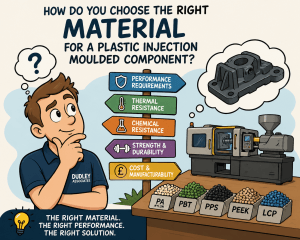
2. Material Selection: More Important Than Many Realise
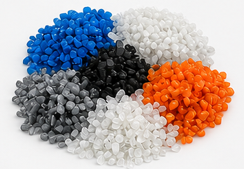
One of the biggest mistakes in product development is treating material selection as an afterthought.
Not all plastics behave the same way.
Choosing the right polymer can influence:
- Mechanical strength
- Temperature resistance
- Chemical compatibility
- Dimensional stability
- Wear resistance
- Regulatory compliance
- Surface appearance
- Manufacturing efficiency
A material that works perfectly in one application and environment may fail completely in another.
This becomes especially important when dealing with technical or high-performance polymers.
At Dudley Associates, we regularly support projects involving engineering-grade materials where precision, repeatability and process control matter.
And importantly, we help customers balance performance with practicality.
Because sometimes the “best” material on paper may not be the best commercial solution.
3. Tooling Strategy Depends on More Than Just Budget
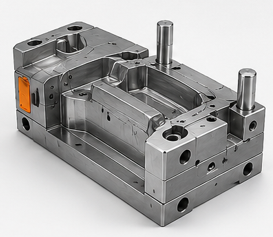
A common question is:
“How much will the mould tool cost?”
The honest answer?
It depends entirely on what the component needs to achieve.
Tooling design is influenced by factors such as:
- Production volume
- Material type
- Tolerance requirements
- Surface finish
- Part geometry
- Automation requirements
- Lifecycle expectations
- Validation requirements
For low-to-medium volume manufacturing, the ideal solution is often very different from a high-volume automotive-style production tool.
This is one of the areas where Dudley Associates offers genuine flexibility.
Because we operate with tooling, moulding and technical support all under one roof, we can tailor manufacturing strategies to suit the actual needs of the project — rather than forcing customers into a one-size-fits-all production model.
For many customers, this is particularly valuable during:
- Product launch phases
- Pilot production
- Bridge manufacturing
- Market validation
- Engineering trials
- Specialist industrial applications
- Evolving product designs
4. Prototype vs Production: Knowing the Difference
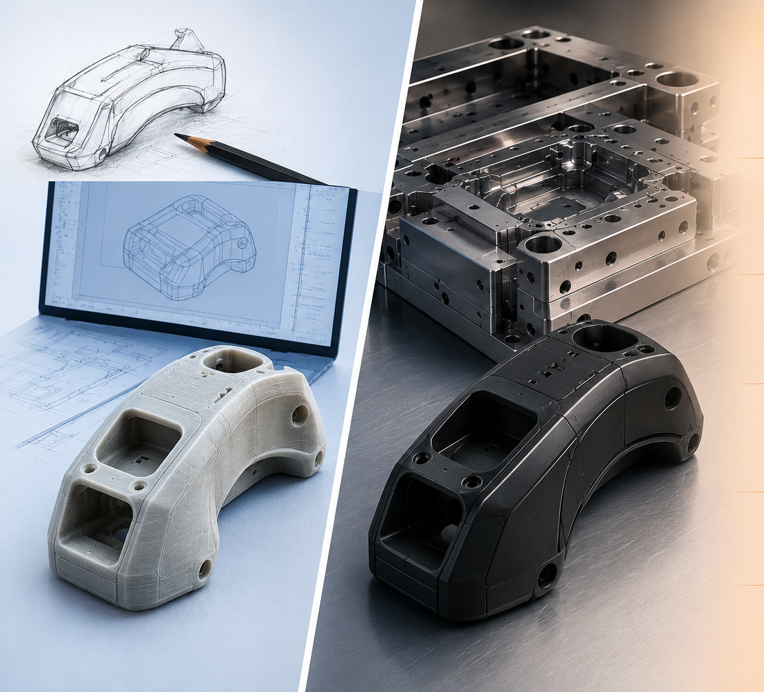
Not every prototype is production-ready.
And not every production tool needs to start as a hardened multi-cavity system.
One of the biggest advantages of working with an experienced injection moulding partner is understanding how to scale a product sensibly.
Sometimes the right route is:
- Prototype tooling first
- Initial low-volume manufacture
- Design refinement
- Then scaled production tooling later
This staged approach can reduce risk significantly.
Especially for:
- New product launches
- Start-ups
- Innovative technical products
- Evolving assemblies
- Uncertain market demand
At Dudley Associates, we regularly support customers bringing entirely new concepts to life — helping bridge the gap between an idea, a CAD model and a manufacturable production component.
5. Why “All Under One Roof” Actually Matters
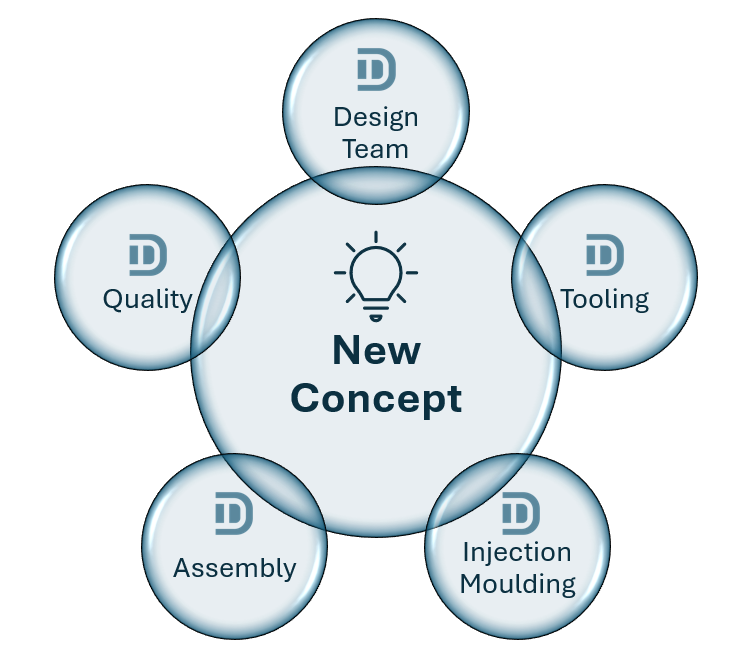
Plenty of companies can mould plastic components.
But one of the biggest causes of project delays is fragmentation.
The tool designer is freelance.
The toolmaker is elsewhere.
The sampling happens somewhere different.
Communication becomes diluted.
Problems take longer to resolve.
Accountability becomes blurred.
By keeping tooling, moulding and technical collaboration closely integrated, projects tend to move faster and more efficiently.
At Dudley Associates, this joined-up approach allows:
- Faster technical feedback
- Better communication between tooling and moulding teams
- Improved manufacturability decisions
- Greater agility during development
- Easier troubleshooting
- More efficient project management
For design engineers, that often means fewer surprises later in the process.
6. Low-to-Medium Volume Manufacturing Is Often Overlooked
A lot of injection moulding content online focuses on massive production runs, and we have some excellent high-volume injection moulders in the UK. But this is not who we are (we can recommend some of our peers if this is a better fit for your project – please ask us the question!).
In reality, many technical products don’t require millions of parts.
Medical devices.
Aerospace and defence components.
Specialist electronics.
Scientific instrumentation.
Emerging technologies.
These sectors often require:
- Lower production volumes
- Higher precision
- Greater flexibility
- Technical collaboration
- Ongoing design evolution
- Specialist material expertise
This is an area where Dudley Associates has built significant experience.
Low-to-medium volume manufacturing is not simply “smaller scale” moulding.
It requires a different mindset.
One focused on engineering support, adaptability and long-term technical partnership.
7. Bringing New Concepts to Life
Some of the most rewarding projects start with a simple conversation:
“We’ve got an idea — but we’re not entirely sure how to manufacture it yet.”
That’s normal.
Many successful products begin with uncertainty.
The key is involving the right people early enough to avoid expensive redesigns later.
At Dudley Associates, we work closely with customers to help transform concepts into practical moulded solutions — whether that means:
- Improving manufacturability
- Advising on material selection
- Refining component geometry
- Supporting tooling strategy
- Developing scalable production plans
- Solving technical moulding challenges
Sometimes the most valuable part of the process isn’t the mould tool itself.
It’s the engineering conversations that happen before production begins.
So… What Should You Do Next?
If you’ve got a product design that needs moulding, the best next step usually isn’t requesting tooling prices from ten different suppliers.
It’s finding a manufacturing partner willing to understand:
- What the component actually needs to do
- What volumes you realistically require
- How the product may evolve
- What technical challenges exist
- What commercial pressures matter most
Because successful injection moulding projects are rarely just about plastic.
They’re about collaboration.
Looking to Bring a Product Concept into Production?
Whether you’re developing a new technical component, refining an existing design or exploring low-to-medium volume manufacture, Dudley supports customers from concept through to production.
With tooling, technical expertise and injection moulding all under one roof, we help design engineers turn ideas into practical, manufacturable products.
Need support with a moulded component design?
Get in touch with the team. We’d love to hear from you.