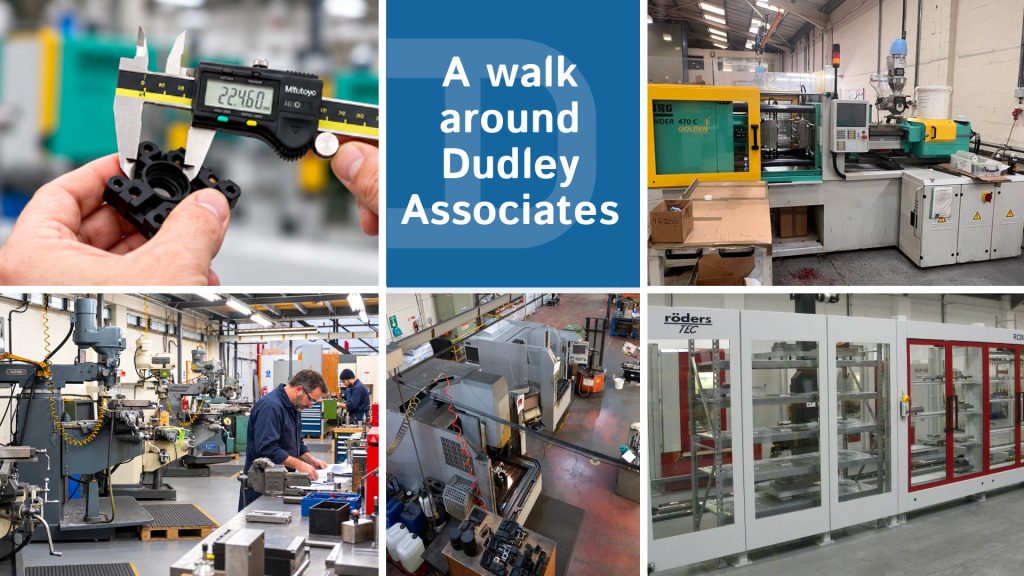
For product designers and engineering teams, choosing an injection moulding supplier is not only about machine capacity, price or location.
One of the biggest practical advantages can be having toolmaking and injection moulding within the same company and the same factory.
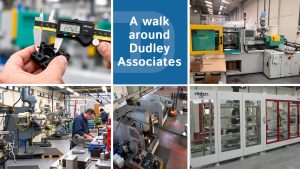
At Dudley Associates, the CAD department, toolroom and injection moulding facility all work closely together. That means the people designing, manufacturing, modifying and running an injection mould tool can communicate directly, without relying on several separate suppliers.
The biggest benefit often becomes obvious when something needs changing.
Why does in-house toolmaking matter during mould trials?
A new injection mould tool is only fully tested once it is put into a moulding machine and used to produce the first components.
Once the tool is loaded and running, the team can see how the component actually fills, cools and ejects, as well as checking the surface finish, dimensions and overall quality of the moulded part.
Sometimes everything is right immediately. At other times, a relatively small modification can make a significant difference to how well the tool performs.
That might involve adjusting an insert, changing the venting, reviewing a shut-off area or making another minor tooling alteration.
The amount of actual toolmaking work may only be small.
The problem is that, when the toolmaker is located elsewhere, the time surrounding that small modification can be much greater than the modification itself.
How much time can be lost when the toolmaker is off-site?
If the injection moulding company does not have its own toolroom, even a straightforward modification can involve a lengthy process.
The mould tool may need to be:
- Removed from the moulding machine
- Prepared and packed for transport
- Loaded onto a vehicle
- Transported to the toolmaker
- Booked into the toolmaker’s production schedule
- Modified
- Packed and transported back
- Reloaded into the injection moulding machine
- Set up and trialled again
If the next trial shows that another change is required, the process may need to be repeated.
A modification requiring only a few hours of machining can therefore turn into several days or even weeks of elapsed time.
The situation becomes more difficult if the original toolmaker is located a long distance away or overseas.
Transport becomes slower and more expensive, and repeatedly moving valuable tooling introduces additional handling and logistical risk.
There is another complication too. If the original toolmaker is no longer involved, another company may have to take over tooling it did not design or manufacture. Understanding somebody else’s tool, its history and any previous modifications can itself take time.
How does Dudley’s in-house toolroom reduce that delay?
At Dudley Associates, the moulding shop and toolroom are within the same facility.
If a modification is required after a trial, the tool can move directly from the moulding machine into the toolroom. In many cases, only the half of the mould requiring attention needs to be removed, which reduces handling and makes the subsequent reload considerably quicker.
The moulding technician can explain directly to the toolmaker what happened during the trial. If required, Dudley’s CAD team can also review the relevant component or tooling feature at the same time.
Once the alteration has been completed, the tool can return to the moulding machine and be tested again.
In the right circumstances, a process that could take days or weeks when several suppliers are involved can be completed within hours.
That can reduce:
- Product development lead time
- Tool transport costs
- Repeated handling
- Machine setup time
- Supplier coordination
- Production delays
- Overall development cost
For a company trying to launch a new product, those savings can be significant.
Why does communication between toolmakers and moulding technicians matter?
Not every injection moulding problem is caused by the moulding process.
If a component flashes, distorts, sticks in the tool, sinks or comes out of tolerance, the cause may lie in the processing conditions, mould tool, component geometry, material or a combination of several factors.
Where the toolmaker and injection moulder are separate companies, identifying the cause can sometimes involve lengthy conversations between suppliers.
When the toolroom and moulding team work together, the discussion is more direct.
The question is not whether the toolmaker or moulder is responsible. The question is what needs to change to produce the correct component.
That joined-up approach can make troubleshooting considerably faster.
What role does CAD play in injection moulding and toolmaking?
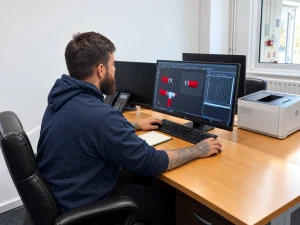
Dudley’s CAD department forms another part of the same manufacturing process.
Component designs, tooling details and proposed modifications can be designed and reviewed alongside the people who will manufacture and operate the mould tool.
This can be particularly useful when a component change is being considered.
Sometimes the right solution is a modification to the mould tool. In other cases, a small change to the component itself may simplify the tooling or improve the way the part is manufactured.
For a product designer, having access to that practical manufacturing input can help avoid unnecessary complexity and cost.
How does automated CNC machining help reduce mould tool lead times?
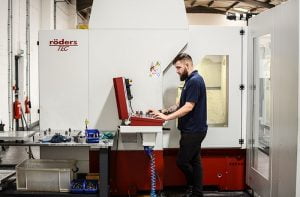
Dudley’s toolroom includes a Röders automated CNC machining cell with robotic loading.
The system can continue machining unattended, including lights-out operation, allowing work to continue beyond the normal working day.
For precision mould tooling, that additional automated machining capacity helps keep projects moving and can reduce lead times on complex tooling components.
It is another example of keeping more of the critical manufacturing process under Dudley’s direct control.
Is an in-house toolroom useful after the product enters production?
Yes.
The benefits continue long after the first production parts have been approved.
Injection mould tools require maintenance during their working life. Components may also change, customers may request design updates, or an existing tool may need repairing or modifying.
Because Dudley Associates can maintain, repair and modify injection mould tools in-house, those changes remain closely connected to the injection moulding process.
This is also valuable when Dudley takes over an existing mould tool from another supplier.
The tool can be inspected, trialled and modified where required within the same facility before being placed into ongoing production.
Does having toolmaking and injection moulding together save money?
Potentially, yes.
The saving is not simply the cost of the tooling modification itself.
Every additional movement between suppliers can involve transport, packing, handling, administration, machine setup and lost production time.
Reducing those handovers can therefore reduce both direct costs and the less obvious cost of delaying a product launch or production programme.
For many product development projects, speed is commercially important.
Getting a mould tool back into the machine quickly can sometimes be worth considerably more than the cost of the modification itself.
Why is this important for product designers?
Product designers should not need to become mould tool experts.
What they do need is access to a manufacturing partner that understands how component design, tooling and injection moulding affect one another.
For product designers and engineering teams, working with an injection moulding company that has an in-house toolroom can provide:
- Faster tooling modifications
- Fewer supplier handovers
- Direct communication between moulders and toolmakers
- Practical design-for-manufacture input
- Faster troubleshooting
- Reduced tool transport
- Lower development costs
- A quicker route from design to production
At Dudley Associates, the toolroom is not simply another department sitting beside the moulding shop.
It is part of the injection moulding process.
Frequently asked questions
Can an existing injection mould tool be transferred to Dudley Associates?
Yes. Dudley regularly works with existing mould tools and can inspect, trial, maintain, repair and modify transferred tooling where required.
Can Dudley modify a mould tool if the product design changes?
Yes. Dudley’s in-house toolroom and CAD capability allow tooling modifications to be designed and reviewed alongside the moulding process.
Does Dudley Associates manufacture mould tooling in-house?
Yes. Dudley has an in-house toolroom with CNC machining, automated Röders machining, spark erosion, fitting, polishing, tool repair and modification capability.
Can Dudley help troubleshoot an injection moulded component?
Yes. Having CAD, toolmaking and injection moulding teams within the same business allows the component, tool and processing conditions to be considered together.
Does Dudley only work with new mould tools?
No. Dudley also works with existing tooling, including tool transfers, maintenance, repair and modifications.
Where is Dudley Associates based?
Dudley Associates is based in Lutterworth, Leicestershire, and supports injection moulding and tooling customers throughout the UK, with particular strength across the Midlands.
A quicker route from design to production
The real advantage of having toolmaking and injection moulding under one roof is not simply being able to list both capabilities.
It is the time saved when those capabilities need to work together.
When a moulding technician can walk a tool into the toolroom, speak directly to the toolmaker and have it back in the machine quickly, a development programme can move at a very different pace.
For product designers looking for an injection moulding partner that wants to be actively involved in making a product work, that can make all the difference.