A design engineer’s guide to cost, performance, tooling and production
Choosing a plastic for a new product can look straightforward at first.
You know what the component needs to do, so you find a material with the required strength, temperature resistance, chemical resistance or appearance and specify it on the drawing.
But that is only part of the decision.
The material you choose can influence the price of every component, how quickly it can be moulded, how complicated and expensive the mould tool needs to be, how long that tool will last, how dimensionally stable the finished component is and even how easily the product can be assembled later.
At the other extreme, simply choosing the cheapest plastic and designing around low tooling and fast production can create its own problems. You may end up with a component that warps, wears, cracks, flexes too much, deteriorates in its operating environment or simply feels cheap.
For most design engineers, therefore, the question should not be:
What is the best plastic for this product?
It should be:
What is the best balance of performance, material cost, tooling cost and manufacturing efficiency for this particular product?
That is where involving an injection moulding and tooling company such as Dudley Associates early in the design process can make a considerable difference.
There is no single “best” plastic for injection moulding
Modern engineering polymers can offer an extraordinary range of properties.
Some are inexpensive, lightweight and fast to process. Others can tolerate high temperatures, aggressive chemicals, repeated mechanical loads or demanding environments. Some offer excellent impact resistance, others rigidity, low friction, optical clarity or electrical performance.
The difficulty is that you rarely get every desirable property in one inexpensive material.
A high-performance engineering polymer might give exceptional temperature and chemical resistance, but cost substantially more per kilogram and require higher processing and mould temperatures.
A glass-filled material might provide considerably more stiffness, but it can also be more abrasive to the mould tool and may introduce different shrinkage or warpage considerations.
A very inexpensive commodity polymer might be quick to mould, but simply not provide the dimensional stability, appearance or mechanical properties the finished product requires.
Material selection is therefore a balancing exercise rather than a search for the highest specification.
At Dudley Associates, we can work with product designers before tooling is commissioned to consider the material alongside the component geometry, tooling approach, anticipated production volumes and eventual moulding process.
A quick comparison of common injection moulding materials
There are thousands of individual polymer grades available, so the table below should be treated as a starting point rather than a material specification.
| Material | Relative material cost | Production characteristics | Common reasons for choosing it | Things to consider |
| Polypropylene (PP) | Low | Generally efficient to mould | Lightweight, chemical resistance, living hinges, good value | Relatively flexible, shrinkage, limited high-temperature performance |
| Polyethylene (PE / HDPE) | Low | Generally efficient | Toughness, chemical resistance, moisture resistance | Lower stiffness, shrinkage and dimensional considerations |
| ABS | Low to medium | Good general-purpose processing | Good appearance, reasonable stiffness and impact resistance | Outdoor/UV performance depends on grade |
| ASA | Medium | Similar applications to ABS | Good appearance with improved weather and UV resistance | Higher cost than basic ABS |
| Polycarbonate (PC) | Medium to high | Requires controlled drying and processing | Very good impact resistance, transparency, heat resistance | Material cost, drying and processing requirements |
| Nylon (PA6 / PA66) | Medium | Well established engineering material | Strength, wear resistance, toughness, glass-filled options | Moisture absorption can affect dimensions and properties |
| Acetal (POM) | Medium | Good production material when correctly processed | Dimensional stability, low friction, gears and mechanisms | Processing and tooling need to be properly considered |
| PBT | Medium | Widely used engineering polymer | Dimensional performance, electrical applications, heat resistance | Often reinforced, which can affect tooling wear |
| TPE / TPU | Medium to high | Application dependent | Flexible grips, seals, protection and overmoulding | Material compatibility, ejection and tooling design |
| PMMA (Acrylic) | Medium | Requires careful processing | Clarity, appearance and light transmission | More brittle than polycarbonate |
| PPS | High | Higher-temperature processing | Chemical and heat resistance, dimensional stability | Cost and demanding tooling/processing requirements |
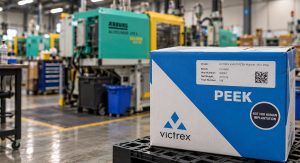
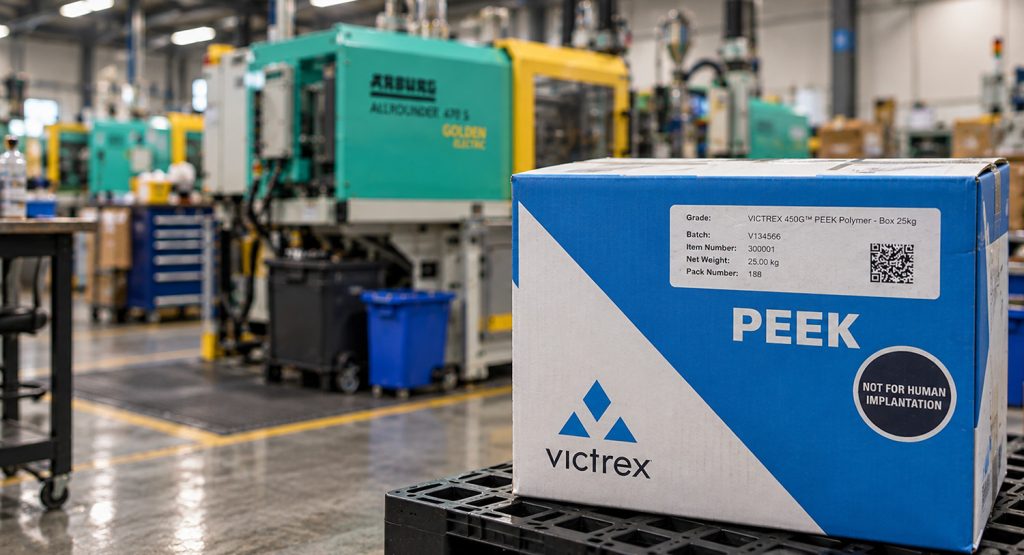
| PEEK | Very high | Specialist high-temperature processing | Exceptional high-performance applications | High material cost and specialist tooling/process requirements |
There can be huge differences between grades within each polymer family.
For example, an unfilled nylon and a 30% glass-filled nylon may share the same basic polymer family but behave very differently in the finished component and during moulding.
That is why Dudley Associates would always look beyond simply seeing “PA66”, “PP” or “ABS” written on a specification.
The grade matters.
How should a design engineer choose an injection moulding material?
Before selecting a polymer, we would normally want to understand several things about the finished product.
What does the component actually need to do?
Start with function rather than material.
- support a mechanical load?
- remain rigid?
- absorb an impact?
- flex repeatedly?
- form a seal?
- resist wear?
- operate as a bearing surface?
- contain pressure?
- remain dimensionally accurate?
- survive outdoors?
- resist chemicals?
- tolerate elevated temperatures?
- look particularly attractive?
- be transparent?
- comply with food, medical or other industry requirements?
Only once those requirements are understood does it make sense to start narrowing down material families.
This sounds obvious, but it can prevent considerable over-specification.
There is little benefit in paying for properties that the product will never actually use.
Strength and rigidity are not the same thing
This is particularly important for product designers.
A material can be strong without being particularly rigid.
Strength broadly describes the ability of a material to withstand a load before failing.
Rigidity or stiffness describes how much it deflects under that load.
Those are different characteristics.
For example, if you’re designing a casing that must not visibly flex when somebody presses it, stiffness may be more important than ultimate strength.
If you’re designing something that may be dropped, impact toughness could be more important.
There are also occasions where a more flexible polymer is deliberately chosen because allowing controlled movement is preferable to producing a very stiff component that cracks.
Geometry plays a part too.
Ribs, curves, wall sections and other design features can sometimes provide the required stiffness without simply moving to a more expensive material or making the entire component thicker.
This is precisely where product design and injection moulding knowledge should meet.
How does plastic material affect injection moulding cycle time?
For high-volume production, this can be enormously important.
The cost of the raw material is only one part of the component price. You are also paying for machine time.
If one component can be produced every 20 seconds and another takes 40 seconds, that difference becomes significant when production reaches hundreds of thousands of parts.
The material affects the process because different polymers require different melt temperatures, mould temperatures, cooling conditions and processing windows.
However, material is not the only influence.
Part geometry, and particularly wall thickness, can have a very significant effect on cooling time. Thick sections contain more heat and take longer to cool sufficiently for safe ejection.
Cooling channel design within the mould also matters.
This is why Dudley Associates considers the part, material, tooling and moulding process together.
Simply specifying a fast-processing material won’t necessarily create a fast cycle if the product design or mould cooling prevents it.
Should you always choose the material with the fastest cycle time?
No.
Production speed needs to be balanced against product performance.
Saving several seconds on the moulding cycle could be extremely valuable on a component produced several million times.
On a specialist product requiring only 2,000 components, the saving may be relatively unimportant compared with ensuring the product performs properly.
The same principle applies throughout material selection.
Production volume changes the economics.
Material choice for short production runs
If a component is only going to be manufactured in relatively small quantities, initial tooling cost often becomes particularly important.
Imagine producing 2,000 components.
If one tooling solution costs £10,000 more than another, that additional investment represents £5 per component before the machine has produced anything.
Now spread the same £10,000 across one million components and it becomes just one penny per component.
That changes the conversation considerably.
For a short-run product, Dudley Associates may therefore look at possibilities such as:
- simpler tooling strategies
- lower numbers of cavities
- rapid or lower-volume tooling approaches
- reducing unnecessary tool complexity
- designing the component to avoid expensive mechanisms
- accepting a slightly higher component price in return for lower initial investment
Material still matters, but saving fractions of a penny on resin or a few seconds of cycle time may be much less important than controlling the original tooling investment.
Material choice for long production runs
High-volume production reverses some of those priorities.
If you’re planning to manufacture hundreds of thousands or millions of components, relatively small improvements become very valuable.
Material price matters more because every penny is multiplied by a large quantity.
Cycle time matters more for exactly the same reason.
Tool reliability and maintenance become increasingly important too.
For longer production runs, it can therefore make commercial sense to invest more heavily in tooling that provides:
- robust long-term production
- efficient cooling
- multiple cavities where appropriate
- reliable ejection
- replaceable wear components
- easier preventative maintenance
- greater process stability
- faster production cycles
The cheapest mould tool is not necessarily the cheapest way of manufacturing a high-volume product.
At Dudley Associates, expected lifetime volume is therefore something we want to understand before the tooling strategy is finalised.
How does the plastic material affect mould tooling cost?
The polymer you select can influence the mould tool itself.
Some reinforced materials contain glass or other fillers which can be abrasive. Over large production volumes, that additional wear may need to be considered when selecting tool steels, surface treatments or replaceable components.
Certain polymers require higher mould temperatures, which influences temperature control within the tool.
Materials can also have different shrinkage characteristics, flow behaviour and venting requirements.
If the product requires a particularly high-quality visible surface or optical clarity, the finish and polishing of the tool become more important.
So although a material doesn’t determine tooling cost on its own, it can certainly influence the level of engineering required.
This is another reason why selecting the polymer after the mould has already been designed can create unnecessary complications.
These considerations become particularly important when working with specialist polymers, as demonstrated in our article on overmoulding copper busbars for powertrain applications.
What if the component needs to be particularly strong?
There is rarely a single answer.
Engineering polymers such as nylon, polycarbonate, PBT and various reinforced materials can provide excellent mechanical performance, depending on what type of strength the application requires.
Glass fibre reinforcement can dramatically increase stiffness in some polymers.
But there are trade-offs.
Filled materials can behave differently during moulding. Fibre orientation can influence the properties of the component in different directions and can contribute to dimensional or warpage considerations.
They can also increase wear within the mould tool.
Rather than simply asking for the strongest possible polymer, Dudley would normally ask:
How strong does this component actually need to be, and where does it need that strength?
A combination of appropriate material and better component geometry can often produce a much better answer.
What if dimensional accuracy is critical?
Material selection becomes especially important where tight tolerances are involved.
Different polymers shrink differently as they cool, and some respond more strongly to changes in moisture, temperature and processing conditions.
Nylons, for example, can absorb moisture from their environment, which must be considered when dimensional stability is important.
Acetal is frequently considered for mechanisms and precision engineering components because of properties such as dimensional stability and low friction, although suitability still depends on the individual application.
For precision mouldings, Dudley Associates can combine material and process knowledge with CMM inspection, allowing dimensional behaviour to be measured and monitored rather than simply assumed.
Choosing plastics for marine environments
A component used around water presents a different set of challenges.
A marine application may need to withstand:
- continual moisture
- salt water
- UV exposure
- changes in temperature
- chemicals and cleaning products
- mechanical loading
- long periods outdoors
Polyethylene and polypropylene can be attractive for certain marine applications because of their moisture and chemical resistance.
UV-stabilised grades may be necessary for prolonged outdoor exposure.
Acetal may suit some mechanical components requiring low friction and good dimensional stability.
Nylon can offer excellent mechanical properties, but its moisture absorption needs to be considered within the design.
There isn’t therefore one universal “marine plastic”.
The correct choice depends on whether the component is permanently immersed, exposed to spray, outside in sunlight, carrying a mechanical load or simply operating in a humid environment.
These are exactly the sorts of questions worth discussing with Dudley Associates before the CAD design is completely locked down.
Choosing injection moulding materials for food applications
Food applications introduce another consideration: compliance.
It isn’t sufficient to say that a particular polymer is commonly used around food.
The specific grade, additives and colourants may all need to satisfy the appropriate food-contact requirements for the intended market and application.
Other considerations can include:
- operating temperature
- cleaning chemicals
- oils and fats
- repeated washing
- staining
- moisture
- surface finish
- hygiene and cleanability
Polypropylene and polyethylene are widely used in many food-related products, while engineering materials such as acetal can be found in mechanical food-processing applications.
Again, the application determines the material rather than the industry name alone.
Dudley Associates can work with customers and material suppliers to identify suitable moulding grades while also considering how that material will influence the mould tool and production process.
Choosing plastics for aerospace applications
Aerospace understandably moves the discussion towards higher-performance polymers.
Depending on the application, engineers may need to consider:
- weight
- operating temperature
- chemical exposure
- mechanical performance
- dimensional stability
- flame performance
- smoke and toxicity requirements
- traceability
- long-term reliability
Materials such as PPS, PEEK and other high-performance engineering polymers can be considered for particularly demanding applications.
But this is also where blindly specifying the “best” material becomes expensive very quickly.
PEEK, for example, can offer exceptional performance, but it comes with a very different raw material and processing cost from polypropylene or ABS.
Higher-performance materials can also require hotter and more sophisticated tooling and tighter control over the moulding process.
If the component does not actually require those properties, you may simply be paying for performance that provides no practical benefit.
For an aerospace design engineer, therefore, the objective should be to define the genuine requirements first and then find the lowest-cost manufacturing solution that safely and consistently meets them.
Not the cheapest material, and not automatically the highest-specification one.
What about medical products?
Medical components can introduce their own material, manufacturing and regulatory requirements.
Considerations may include biocompatibility, sterilisation methods, chemical resistance, traceability and contamination control.
Some applications may also require production within a controlled environment.
Dudley Associates operates an ISO Class 8 cleanroom, allowing us to support injection moulded components where controlled manufacturing conditions are required.
As with food applications, individual material grades and their documentation are extremely important.
Choosing the correct polymer family is only the first stage.
Electronics and electrical products
For electrical enclosures, connectors and similar components, designers may be looking for a different combination of properties again.
These can include:
- electrical insulation
- dimensional stability
- temperature resistance
- impact resistance
- appearance
- flame-retardant performance
- accurate features for assembly
Materials such as ABS, PC/ABS, polycarbonate and PBT are widely encountered in electronic and electrical applications, depending on the exact requirements.
This is also an area where relatively small design details can have a large effect on tooling and moulding.
Snap features, bosses, ribs, connector details and thin walls all need to work with the chosen polymer rather than simply being added to the CAD model independently of it.
Automotive applications
Automotive components demonstrate particularly well why there is no single ideal injection moulding material.
A visible interior trim component has completely different requirements from an under-bonnet component.
Different applications may prioritise:
- low weight
- cost
- appearance
- stiffness
- impact resistance
- chemical resistance
- heat resistance
- UV stability
- noise and vibration
- dimensional stability
Polypropylene and related materials are extensively used where low weight and good economics are important, while engineering materials such as nylons and PBT may be selected for more demanding technical applications.
Once again, what the part has to do determines the material choice.
Should recycled plastics be considered?
Increasingly, yes.
Modern material selection is no longer purely about mechanical properties and price.
Many manufacturers are considering recycled content, recyclability, carbon impact and end-of-life requirements alongside traditional engineering factors.
There are now many polymers available with recycled content, including some engineering grades.
However, recycled material should not simply be substituted without understanding the implications.
Depending on the source, grade and application, designers may need to consider:
- consistency
- colour
- mechanical properties
- surface appearance
- regulatory requirements
- traceability
- processing behaviour
A recycled polymer can be an excellent choice where it meets the product’s requirements.
As with virgin material, the key is selecting it deliberately rather than simply because one specification looks attractive.
For a practical example, read about how Dudley Associates overcame material selection challenges during a prototype tooling project involving recycled polypropylene.
Why wall thickness matters almost as much as the material
One of the easiest ways of making a component feel stronger is simply to make it thicker.
Unfortunately, that isn’t always the best way to design an injection moulded component.
Increasing wall thickness means using more material, which immediately increases component cost.
Thicker sections also take longer to cool.
They can increase the likelihood of problems such as sink marks, internal stresses or distortion.
In many cases, strategically positioned ribs or other structural features can increase stiffness without adding excessive material.
This is a good example of why Dudley Associates encourages early design involvement.
Sometimes improving the geometry allows you to use a less expensive polymer, reduce material consumption, shorten cycle time and achieve a better component.
Don’t choose the material in isolation from the tool
One of the most important messages for any product designer is this:
The plastic component, material, mould tool and manufacturing process are not separate decisions.
They affect each other.
Changing material can alter shrinkage.
Shrinkage influences tool dimensions.
Material flow can influence gate positions and wall sections.
Cooling influences cycle time.
Surface finish can influence tooling requirements.
Production volume influences how much it makes sense to invest in the mould.
Component geometry influences whether an inexpensive polymer will perform adequately or whether a higher-performance grade is needed.
If these decisions are made together, compromises can often be avoided.
If they’re made separately, problems tend to appear later when they are more expensive to correct.
A simple material selection checklist for design engineers
- What does the component have to do mechanically?
- Does it need stiffness, strength, toughness, flexibility or a combination?
- What temperatures will it experience?
- Will it be exposed to water, UV, chemicals, oils or cleaning products?
- Does appearance matter?
- Are there regulatory or industry-specific requirements?
- How dimensionally accurate does it need to be?
- How many components will ultimately be manufactured?
- What production cycle and component price are commercially acceptable?
- What level of tooling investment makes sense for that volume?
- Will components require assembly, inserts or secondary operations?
- Does sustainability or recycled content form part of the brief?
- Could the component geometry be changed to make moulding easier or reduce material use?
- Has the proposed material been considered alongside the mould tool rather than in isolation?
You don’t necessarily need to know all the answers yourself.
That is part of the value of involving people who design tools and manufacture injection moulded components every day.
So what is the cheapest plastic for injection moulding?
There isn’t one answer that works for every component.
Commodity polymers such as polypropylene and polyethylene can offer very attractive material costs and efficient processing, which is why they’re used so extensively.
But they are only inexpensive if they actually meet the product requirements.
A failed component is expensive regardless of how cheaply the resin was purchased.
Likewise, specifying a premium engineering polymer when a less expensive material would comfortably meet the requirement is simply unnecessary cost.
The correct question is:
What is the lowest overall manufacturing cost that still gives the product the performance, quality and reliability it needs?
That considers much more than the price per kilogram.
What is the fastest plastic to injection mould?
Again, there is no universal answer.
Material properties affect processing speed, but so do:
- component wall thickness
- tool cooling
- number of cavities
- mould temperature
- component geometry
- ejection
- machine selection
- processing conditions
A well-designed component in an appropriate material and a properly designed mould can often be produced much more efficiently than a poorly designed component made from a theoretically “fast” polymer.
At Dudley Associates, the objective is not simply to run the injection moulding machine as fast as possible.
It is to establish a stable, economical and repeatable process that produces the required component consistently.
The best time to discuss material is before the design is finished
Perhaps the most useful advice in this entire guide is also the simplest.
Don’t wait until the product design is completely finished before talking to the people who will tool and mould it.
You are the expert in what your product needs to do.
Dudley Associates can bring another perspective: how the material, component design, mould tool and injection moulding process will work together in production.
Sometimes that may result in a different polymer.
Sometimes it means changing a wall section, radius, rib or feature.
Sometimes the original material choice is absolutely right.
The important thing is finding that out before expensive tooling is commissioned rather than afterwards.
Dudley Associates can support projects from early product and material discussions through design for manufacture, mould toolmaking, tool trials, injection moulding, CMM inspection, cleanroom production, secondary operations, assembly and ongoing production.
Whether you need a short test batch or a component that will eventually be produced in its millions, the aim is the same:
The right material, the right tool and the right manufacturing process for the product you actually need to make.
Frequently Asked Questions
What is the best plastic for injection moulding?
There is no single best plastic. The correct material depends on the required strength, stiffness, impact resistance, operating temperature, chemical exposure, appearance, regulatory requirements, production volume and acceptable component cost.
Does plastic choice affect mould tool cost?
Yes. Abrasive filled polymers, higher processing temperatures, surface-finish requirements, shrinkage and other material characteristics can influence tool steel selection, temperature control, wear protection and overall mould design.
Does material choice affect injection moulding cycle time?
Yes, although component geometry and tool cooling are also major influences. Different polymers require different processing and mould temperatures, and some components need longer cooling or holding times before they can be safely ejected.
Which plastics are best for high-volume injection moulding?
It depends on the application. For high-volume production, material price, cycle time, consistency, tool wear and long-term reliability become particularly important. PP, PE, ABS and many engineering polymers can all be excellent high-volume materials when matched correctly to the product.
What plastic should I use for a short production run?
For lower volumes, tooling investment may have a greater influence on overall economics than tiny differences in cycle time or resin price. Material should still meet the product requirements, but the tooling and production strategy can often be simplified.
Can Dudley Associates help choose an injection moulding material?
Yes. Dudley Associates can work with product designers at an early stage to consider material properties alongside manufacturability, tooling, expected volumes, processing requirements, inspection and eventual component cost.